


Flaxseeds have been around for thousands of years and have been a very popular health food for over 30 years in the modern era of superfoods and fads. Flaxseeds aren’t a fad; they are a true superfood, typically under-promising and over-delivering their benefits. Here is your comprehensive guide to flaxseeds and blood pressure, so you will know what to expect if you have hypertension and start eating flaxseeds. Here you can also learn how to incorporate them into your diet. If flaxseed were a medicine, it would be the best single blood pressure medication on the market, hands down, with side benefits (not side effects) of improved cardiovascular health, improved mental health, and improved gut health. There isn’t an organ system in the body that isn’t improved by a serving of ground flaxseeds a day. Let’s dive in, shall we?
- I. Introduction: The Significance of High Blood Pressure
- II. Understanding Blood Pressure
- III. Flaxseeds: Nutritional Powerhouse
- IV. Mechanisms of Lowering Blood Pressure with Flaxseeds
- V. Evidence that Flaxseeds Lower Blood Pressure
- VI. Incorporating Flaxseeds into Your Diet
- VII. Precautions and Disclaimers
- VIII. FAQs
- IX. Conclusion
I. Introduction: The Significance of High Blood Pressure
Let’s talk about blood pressure for a minute. Unlike your pulse, you can’t feel your blood pressure. It is called the “silent killer” for a reason. Many people don’t realize they have high blood pressure until a doctor happens to measure it at a visit for some unrelated incident, or they have a stroke due to high blood pressure. About 1.3 billion people in the world have high blood pressure, also known as hypertension. The WHO Global report onhypertension states that hypertension was found to be the single most important risk factor for early death worldwide, resulting in 10.8 million avoidable deaths every year, and 235 million years of life lost or lived with a disability annually. Needless to say, high blood pressure is a big deal.
II. Understanding Blood Pressure
Blood pressure is measured as a combination of two numbers. The top number, systolic blood pressure, is the maximum pressure your arteries experience as your heart contracts. The bottom number, diastolic pressure, is the resting pressure of your cardiovascular system between heart contractions. The top number, systolic pressure, is the one doctors tend to use for treatment guidelines.
Here is a brief table of blood pressure numbers. Included is a category for optimal blood pressure, which is applicable to adults of all ages.
Table 1. Blood Pressure Categories.
| Blood Pressure Category | Systolic Blood Pressure, mm Hg | Diastolic Blood Pressure, mm Hg |
| Normal | <120 | <80 |
| Optimal | 90-110 | 60-70 |
| Elevated | 120-129 | 80-89 |
| Hypertension | ||
| Stage 1 | 130-139 | 80-89 |
| Stage 2 | ≥140 | ≥90 |
Aging: The Greatest Risk Factor for High Blood Pressure
The biggest risk factor for high blood pressure is age. As people get older, they tend to get high blood pressure. A study of 55- to 65-year old members of the Framingham Heart Study cohort that didn’t have high blood pressure initially showed their residual lifetime risk of hypertension was 90%. That is pretty much everybody, unless you are doing something very different from everyone else around you. (More on that in a minute.)
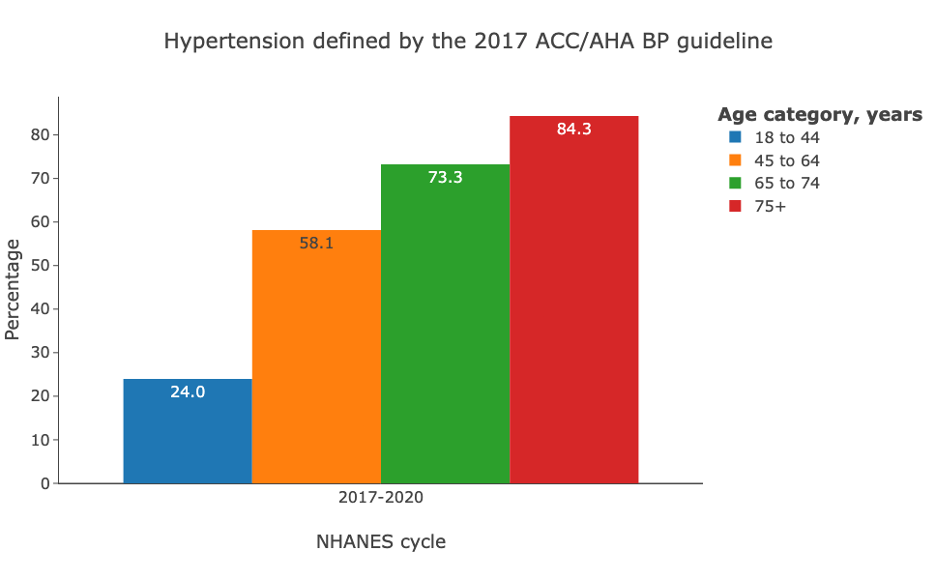
Here is a graph from the NHANES nationally representative dataset, showing the percentage of adults in different age categories who have hypertension, as indicated by their blood pressure or taking anti-hypertensive medication. This graph shows that age is the major risk factor for getting hypertension in the USA. It just seems to be part of getting older.
Doctors and medical scientists often call high blood pressure “essential hypertension.” It isn’t because you have to have it (though it appears that pretty much everyone gets it), but because they don’t really know why people get high blood pressure.
Diet: A Major Risk Factor for Elevated Blood Pressure
A second important risk factor is diet. And we know this because there are entire populations that don’t get high blood pressure. We might want to see what these populations are doing differently.
A 1929 survey of men from four African tribes in Kenya found no elevation in blood pressure with advanced age. Even among men estimated to be over the age of 60, the average blood pressure was 106/67. The comparison group of Europeans was said to have blood pressures ≥140/90 back in 1929. And even with modern medication, the results are not much better in 2024. Some things haven’t changed much in 100 years.
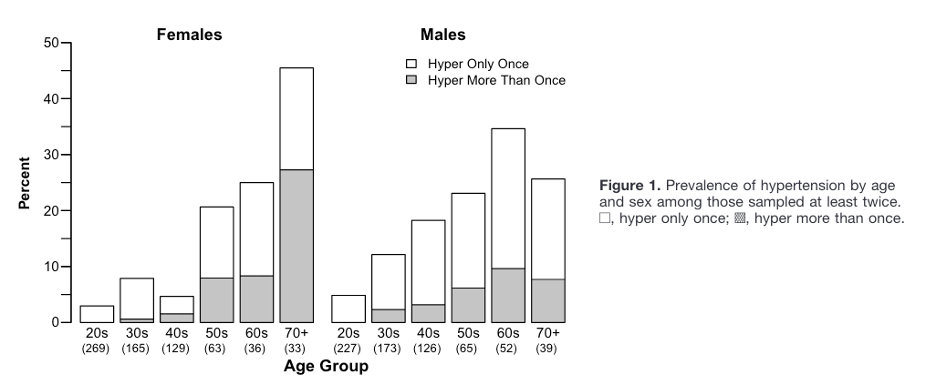
In fact, a 2012 report of the Tsimane forager-farmers in Bolivia also shows that hypertension is not inevitable with advancing age. In women over the age of 70, the prevalence of hypertension is still less than 30 percent, and among men, it is less than 10 percent. Their traditional lifestyle protects them from hypertension, which is a disease of civilization.
But all is not lost. You don’t have to forgo civilization to have optimal blood pressure. While it is true that the greatest effects come from the greatest changes in dietary and lifestyle habits (a subject for another article), you can eat some foods, like flax seeds, that produce large effects with small changes.
III. Flaxseeds: Nutritional Powerhouse
Nutrient Composition of flaxseeds
Flaxseeds are a superfood. They overdeliver on what they promise. These humble, little brown or golden colored seeds are rich in fiber, protein, minerals, and plant-based omega-3 fats. About 57% of the oils in flaxseeds are omega-3 fats, namely alpha-linolenic acid (ALA). A 30-gram (1/4 cup) serving of flaxseeds has about 6 g protein, 13 g fat (7.2 g ALA), 8.6 g fiber (29% RDI), 0.5 mg vitamin B1 (thiamine) (43% RDI), 80 mg calcium (10% RDI), 123 mg magnesium (29% RDI), 256 mg potassium (8% RDI), 1.4 mg zinc (12% RDI), and 0.4 mg copper (43% RDI). Now, that may not look like a multivitamin / multimineral supplement label to you, but flaxseeds offer good quantities of nutrients that we Americans don’t get enough of, like magnesium, potassium, fiber, and omega-3 fats.
Health Benefits of Flaxseeds Beyond Blood Pressure
The fiber in flaxseeds has benefits for gut health, and when your gut is healthy, all the other systems of your body function better, even your brain. The fiber also slows down the absorption of sugar, which can be a benefit for people with diabetes, helping them control blood sugar levels, feel full faster, and perhaps help them lose the weight they need to reverse diabetes. The omega-3 fat in flaxseeds, alpha-linolenic acid, is great for your heart and brain. Several studies point to a reduction in breast cancer risk due to flaxseed, and a pilot study indicated a positive effect on prostate cancer as well. The lignans in flaxseed have been shown to be cancer protective in several animal model studies. These little seeds are just bursting with goodness for you.
IV. Mechanisms of Lowering Blood Pressure with Flaxseeds
Role of Omega-3 Fats in Blood Pressure Regulation
Omega-3, fats can help with blood pressure in several ways. And even though ALA doesn’t have all of these effects directly, it is easily converted into eicosapentaenoic acid (EPA) which does have all of these effects.
Here is how omega-3 fats help with blood pressure:
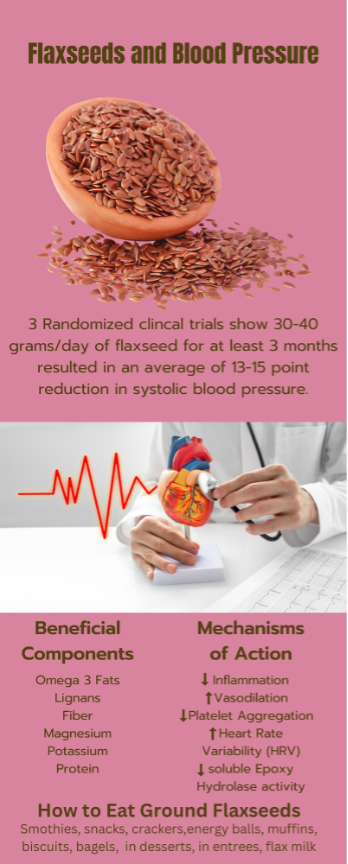
- Omega-3 fats are anti-inflammatory. This helps prevent dysfunction of the endothelial cells, which make up the inner lining of the blood vessels.
- Omega-3 fats help with vasodilation through the production of nitric oxide.
- Omega-3 fats also prevent platelet aggregation, making the blood less sticky, less likely to clot, and to flow better.
- Omega-3 fats also modulate the autonomic nervous system, and can improve heart rate variability (HRV), which is an indication of better heart health and lower risk of sudden cardiac arrest.
- There is an enzyme called soluble epoxide hydrolase that breaks down beneficial oxylipins (metabolic products of essential fatty acids) into products that increase inflammation and decrease vasodilation. ALA has been shown to inhibit soluble epoxide hydrolase, leaving more oxylipins intact that help lower blood pressure.
Lignans and Blood Pressure Regulation
The lignans in flaxseed also play a role in dealing with hypertension. A small 6-month study of 60-80 year old adults showed that a flaxseed lignan-enriched complex taken once a day significantly lowered systolic blood pressure in those participants with hypertension from 155 ± 13 mm Hg to 140 ± 11 mm Hg. This reduction in systolic blood pressure is similar to what has been seen with ground flaxseeds. So, the lignan effect is separate from the presence of omega-3 fat or fiber. The 600 mg of SDG used in this study is about what you would get from a 30-gram serving of ground flaxseeds, showing that the lignans are indeed a potent part of the flaxseed package.
Magnesium and Blood Pressure
Magnesium has also been associated with lower blood pressure, working through several mechanisms, and a 30-gram serving of flaxseeds contains 123 mg of magnesium. This is about 30 percent of the RDI for an adult man, but almost 40 percent of the RDI for an adult woman. For women with hypertension, it was found that about 120 mg more per day of dietary magnesium resulted in a 37 percent decrease in the risk of cerebral infarction (a kind of stroke). So, a serving of flaxseed, which provides this amount, could make a very significant difference in your lifespan.
Arginine and Nitric Oxide Production
There are some claims that the arginine in flaxseeds is helpful for lowering blood pressure. While it is true that the supply of arginine is crucial to the production of nitric oxide by endothelial cells, a 30-gram serving of flax provides between 500 and 700 mg of arginine, which isn’t enough by itself to make a clinical difference.
So, it appears that the complete package of flaxseeds with omega-3 fats, lignans, magnesium, and fiber works together to maintain blood pressure in the normal range. Just one component of flaxseed by itself is not as effective as eating the whole flaxseed. Several different additive mechanisms of action are active when you eat flaxseeds.
V. Evidence that Flaxseeds Lower Blood Pressure
Randomized Controlled Trials for Flaxseed
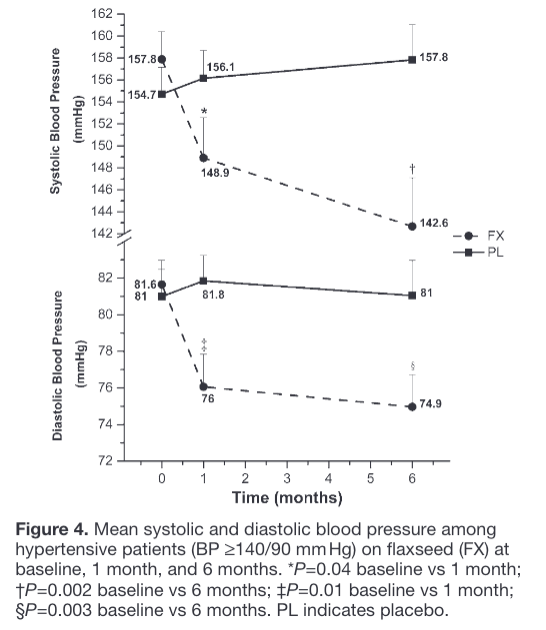
There are two main clinical studies that used enough whole ground flaxseed for a long enough period of time to see a significant difference. In 2013, the FLAX-PAD trial was a randomized, controlled trial of people with peripheral artery disease (PAD) in which one group consumed 30 g of ground flax in bagels, bars, muffins, biscuits, and pasta while the other group had the same foods with wheat, a little bran, and molasses in them to disguise them.
After the 6-month trial ended, participants who had started with hypertension (systolic blood pressure over 140 mm Hg) had reduced their systolic blood pressure by 15 points and their diastolic blood pressure by 7 points. This degree of blood pressure reduction by a simple dietary intervention has not been repeated.
The second flaxseed trial was published in 2021, in which participants consumed 30 g of ground flaxseed, 10 g of ground flaxseed, or a placebo for 12 weeks. At the end of the 30 g/day flaxseed group had lowered their blood pressure by 13 points, the 10 g/day flaxseed group lowered their blood pressure by about 10 points, while the placebo group’s blood pressure went up 1.7 points. However, there was a significant difference between the starting values for the placebo group and the 30 g/day flaxseed group, so that at the end of the study the groups had the same average systolic blood pressure (137.1 and 135.0 for the placebo and 30 g/day flaxseed groups, respectively, see Figure 5.) This unfortunate flaw in the data makes it difficult to draw strong conclusions from this trial. However, the 30 g/day of flaxseed did make a significant change in systolic blood pressure over time, which has never happened in a placebo group.
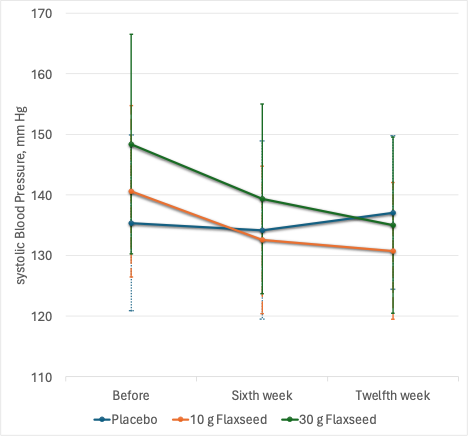
Figure 5. Effect of flaxseed on systolic blood pressure. Data from Toulabi et al (2021). There was a significant drop in systolic blood pressure over time for both flaxseed groups, but not for the placebo group. The placebo group is significantly different from the 30-g/day flaxseed before the trial but not at the end; the placebo is significantly higher than the 10-g/day flaxseed at the twelfth week.
These two trials, along with the flax lignan-enriched complex trial, show that a 13 to 15 point drop in systolic blood pressure, along with a significant drop in diastolic blood pressure, is quite possible with flaxseed, provided you take enough of it for long enough time.
Comparison of Flaxseed to Hypertensive Drugs
The best results from hypertensive drugs with the least side effects appears to be from a combination of three or even four different classes of drugs used at low dose, with a reduction of 18 mm Hg compared to placebo. So, the results from taking flaxseed are just slightly less than state-of-the-art blood pressure drugs. But the flaxseeds come with positive side benefits rather than negative side effects.
VI. Incorporating Flaxseeds into Your Diet
Practical Tips for Including Flaxseeds
There are many ways to include flaxseeds in your diet. As in the Flax-PAD trial, flaxseed can be included in recipes for muffins, biscuits, rolls, bagels, and other grain-based foods. The actual temperatures of the grain product while being cooked are not so high (~200°F) that the fragile omega-3 oils are damaged.
Flaxseeds can be ground and added to granola recipes. Ground flaxseed can also be added to cooked cereals like oatmeal and steel-cut oats.
Flaxseed crackers are also a way to get lots of flaxseed in a delicious snack. A dehydrator or oven set to its lowest temperature can be used to dehydrate the crackers.
Flaxseeds can be added to fruit smoothies as well. Up to 2 tablespoons can be added to a glass of cold smoothie with only a small impact on thickness and flavor. Hallelujah Diet has a recipe section with more than a dozen smoothie recipe ideas that incorporate flax into them.
Ground flax products such as B-Flax-D, which is a room-temperature stable ground flax product fortified with vitamin B-12, B6, D, K2, selenium, and zinc, can even be stirred into water or juice and drunk as a beverage. While this may not be the most pleasant experience, it does get the job done.
Websites with More Flax Recipes
Manitoba Milling Co. has a website with a wide range of recipes for flax, from smoothies and beverages, breakfast recipes, sides, snacks, salads, desserts, and entrees. They even have a flax milk product! Golden Valley Flax also has a similar section with recipes to include flax in entrees, energy bars, granola, smoothies, desserts, muffins, and breads.
VII. Precautions and Disclaimers
Because of the fiber in flaxseed, some medications should be taken one hour before or 3 hours after eating flaxseed. If you are under the care of a healthcare professional, consider asking them whether flaxseeds would interfere with any medication you are currently taking. This article is for educational purposes and is not intended to diagnose, treat, mitigate or cure any disease and does not replace medical advice from your health care team.
VIII. FAQs
IX. Conclusion
Flaxseeds have many benefits for those who eat them. Three randomized clinical trials have shown that 30 grams of flaxseed per day for over 12 weeks results in an average decline of 13-15 mm Hg in systolic blood pressure. The fiber, omega-3 oils, lignans, magnesium, and potassium all combine to reduce inflammation, improve endothelial cell function, enhance vasodilation, and increase the concentration of oxylipins that support normal blood pressure maintenance. In addition to lowering blood pressure, flaxseeds support overall heart health, brain function, gut health, mood stability, and the immune response to infections and rogue cancerous cells. Flaxseeds are indeed an ancient superfood that has earned a spot in healthy modern diets.
