
In a recent blog, I highlighted the American Diabetes Association’s 2025 Standards of Care. The ADA now considers diabetes remission a clinical endpoint, and it can be achieved with sustained weight loss of more than 10%. This is the key factor in helping people achieve diabetes remission.
This isn’t just a theory anymore. It’s a realistic endpoint backed by strong evidence from randomized controlled trials. In this blog article, I want to point out four studies that provide evidence. These studies show that targeted weight loss can reverse prediabetes and type 2 diabetes. Let’s go!
Study 1: Type 2 diabetes remission and its predictors in an Indian cohort: A retrospective analysis of an intensive lifestyle intervention program
In a retrospective analysis published in PLOS One on October 22, 2025, researchers from India’s Freedom from Diabetes Clinic examined 2,384 adults with T2D (aged 30–75, BMI ≥23 kg/m²) who joined a one-year online intensive lifestyle intervention (ILI). This program featured a personalized plant-based diet, physical activity, stress management, and no heavy reliance on medications for drug-naïve participants. And they got great results.
After the intervention, 744 participants (31.2%) had remission of diabetes. Remission is defined as HbA1c ≤ 6.5% without meds for ≥ 3 months. The people who reversed their diabetes had significantly greater improvements in body weight, BMI, HbA1c, fasting insulin, and measures of insulin resistance.
The main predictors of remission included:
- Age being less than 50 years
- A higher BMI at the beginning (greater than 25 kg/m^2)
- Not having used drugs before for diabetes
- A shorter disease duration (less than six years)
- Juice fasting
- A baseline HbA1c less than 7%
- A weight loss greater than 10%
- A post-intervention HOMA-IR less than 2.5
Study 2: Early weight loss, diabetes remission, and long-term trajectory after diagnosis of type 2 diabetes: a retrospective study
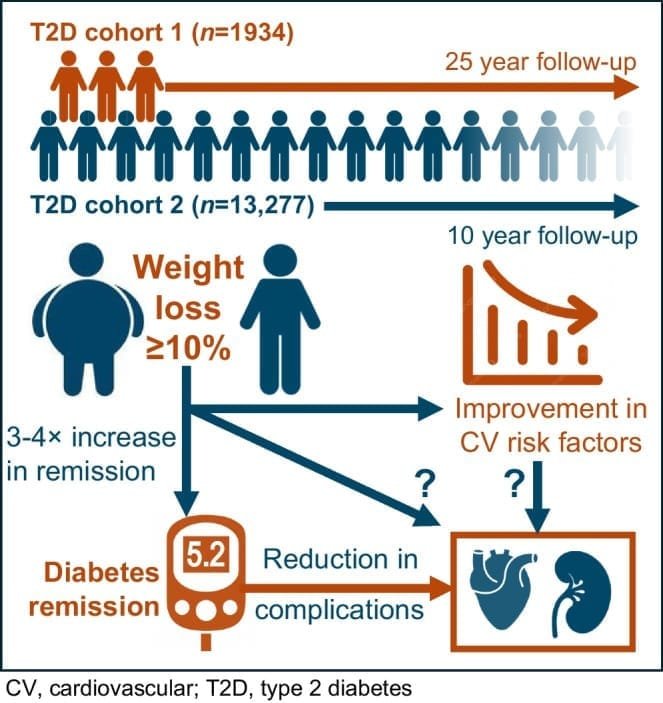
In this study, published in March 2025 in Diabetologia, the researchers sought to determine whether losing more than 10% of body weight had a long-term effect on diabetes. They worked with two groups of people who were newly diagnosed with type 2 diabetes, who were followed for 10 to 25 years, depending on which cohort they were in (see the figure below).
They categorized people into two groups by whether or not they had lost at least 10% of their body weight. At the beginning of the study, the average age was 62 years, and most participants had had diabetes for less than 2 years. The average BMI was about 30 kg/m2. Losing more than 10% of the body weight was associated with a 4X greater chance of remission of diabetes. In this study, people were not instructed to lose weight. They were participants in a clinical practice, and they lost weight on their own and had better results.
Study 3: Behaviour change, weight loss and remission of Type 2 diabetes: a community‐based prospective cohort study
In the ADDITION-Cambridge trial, 867 adults with newly diagnosed Type 2 diabetes were followed for 5 years. At the 5-year follow-up, 257 (30%) had diabetes remission. Participants who achieved 10% weight loss within the first year after diagnosis were twice as likely to achieve diabetes remission at 5 years. The people in this study achieved this weight loss without an intensive lifestyle intervention or extreme calorie restriction. I think this shows that you can do this on your own. But it works better if you get some support from someone who can encourage you and keep you accountable. Remission rates are pretty low in these studies that just let people do it by themselves. But check out the next one, where an intense intervention got much better results.
Study 4: Effect of hypoglycemic agents with weight loss effect plus a high protein diet and moderate exercise on diabetes remission in adults with obesity and type 2 diabetes: a randomized controlled trial
In this randomized controlled trial, published in BMC Medicine (May 6, 2025), 61 obese Chinese adults (BMI ≥28) with new prediabetes or T2D were studied. The intensive group received standard medicines with weight-loss agents (like GLP-1 agonists), a high-protein diet (1.2–1.6 g/kg body weight), and supervised moderate exercise (150–300 min/week aerobic plus resistance). After 12 months of intervention, 86.7% of the T2D subgroup hit remission (vs. 16.7% controls), with 73.3% of prediabetics normalizing glucose. The results were driven by a 19 kg average weight loss, which is a LOT. The higher protein intake, coupled with resistance training, helped them not lose any significant muscle while losing large amounts of body fat. This trial is much smaller than the other ones, but the intervention was more intense and got better results. This study gives you an idea of how to lose lots of weight and preserve muscle mass at the same time.
The Takeaway: >10% Weight Loss Works to Reverse Type 2 Diabetes
These studies echo the ADA’s >10% weight loss benchmark, which was published before any of these studies were in print. The different study designs show that there are various ways of achieving this weight loss. Some people did it all on their own. Some people had an intense intervention to make it happen. Regardless of how exactly they did it, the message is clear: losing weight to reduce excess fat, especially around the internal organs, helps people normalize blood sugar levels and improve glucose control.
You can do this on your own, but working with a health coach or even someone to keep you accountable can help you get better results, faster, and with less frustration. Set up a call if you are ready to work with me.
